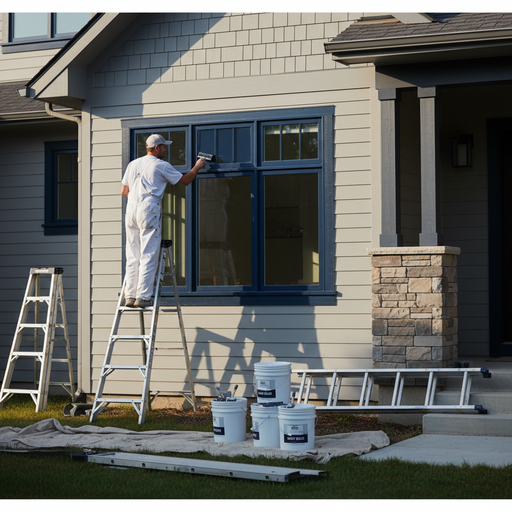
The Real Cost of Custom Exterior Painting: A Comprehensive Guide to Boosting Your Home’s Curb Appeal

SUBMIT YOUR DETAILS FOR
Imagine pulling into your driveway after a long day at work. Instead of the faded, peeling siding that has been bothering you for years, you are greeted by a vibrant, sophisticated palette that makes your home look like it belongs on the cover of an architectural magazine. This is the power of a custom exterior paint job. But before you pick up a brush or call a contractor, there is a big question looming in the air: how much is this actually going to cost?
When we talk about “custom” exterior painting, we aren’t just talking about slapping a single layer of beige on every wall. We are talking about tailored color schemes, meticulous preparation, high-end finishes, and the kind of attention to detail that makes a Victorian trim pop or a modern stucco finish glow. Understanding the costs involved is the first step in turning your vision into a reality without breaking the bank.
Breaking Down the Numbers: What’s the Average Price Tag?
If you search the internet, you will see a wide range of prices. In the United States, most homeowners pay somewhere between $3,000 and $10,000 for a professional exterior paint job. However, for a truly “custom” project on a larger or more complex home, it is not uncommon to see quotes ranging from $12,000 to $20,000 or more.
Why the massive range? Because every home tells a different story. A single-story ranch with smooth siding requires much less labor than a three-story Queen Ae with intricate gingerbread trim and five different accent colors. To understand where your house fits on this scale, we need to look at the individual “ingredients” of a painting quote.
1. The Size and Height of Your Home
It sounds simple, but square footage is the primary driver of cost. Painters calculate the “paintable area,” which excludes windows and doors but includes the height. A two-story home doesn’t just have more surface area; it requires ladders, scaffolding, and extra safety equipment. Working 20 feet in the air is slower and riskier than working at ground level, and you will see that reflected in the labor costs.
2. Preparation: The Secret to Longevity
I once knew a homeowner who chose the cheapest quote he could find. The painters arrived, sprayed the house in two days, and left. Six months later, the paint was bubbling and flaking. Why? They skipped the prep work. In custom painting, prep work often accounts for 50% to 60% of the total labor time.
A high-quality job includes:
- Power Washing: Removing dirt, mildew, and chalking paint.
- Scraping and Sanding: Ensuring the new paint has a smooth, solid surface to grip.
- Caulking and Patching: Sealing gaps around windows and repairing cracks in wood or stucco to prevent moisture intrusion.
- Priming: Using high-quality primer on raw wood or repaired areas to ensure color uniformity.
If your home is older and has multiple layers of failing paint, the preparation cost will rise significantly, but it is an investment that ensures your paint job lasts 10-15 years instead of three.
3. Materials and Surface Texture
Not all walls are created equal. The material of your home’s exterior dictates how much paint is needed. For example, smooth wood siding or vinyl is relatively easy to cover. However, porous materials like brick, stucco, or rough-cut cedar act like a sponge. They require significantly more gallons of paint to achieve a full, even coat.
Furthermore, the quality of the paint itself matters. Custom jobs usually utilize “Premium” or “Ultra-Premium” lines from brands like Sherwin-Williams or Benjamin Moore. These paints have higher solids content, meaning they cover better, resist UV fading longer, and stay flexible during temperature changes. While a gallon of budget paint might cost $35, a premium gallon can run $70 to $90. For a large house requiring 30 gallons, that difference adds up.
4. The Complexity of the Color Scheme
This is where the “custom” aspect really comes into play. A standard paint job usually involves two colors: one for the body and one for the trim. A custom job might involve three, four, or even five colors.
Think about it: every time a painter switches colors, they have to clean brushes, swap out sprayers, and carefully mask off the previous color. Intricate details like window sashes, shutters, corbels, and decorative railings require steady hands and small brushes. The more “detail work” you request, the more man-hours are added to the quote.
5. Regional Labor Rates
Where you live plays a massive role in custom exterior painting costs. A professional crew in a high-cost-of-living area like San Francisco or New York City will charge significantly more per hour than a crew in a rural Midwestern town. Insurance, licensing, and overhead for contractors vary by state, and these costs are passed down to the homeowner.
DIY vs. Professional: Is It Worth the Savings?
It is tempting to look at a $6,000 quote and think, “I can do that myself for the cost of the paint.” And while you certainly can, you must account for the “hidden” costs of DIY. You will need to buy or rent ladders, a power washer, a high-quality sprayer, drop cloths, and safety gear. More importantly, you have to value your time. Painting a whole house correctly usually takes a DIYer several weeks of weekends. If you miss a step in the prep process, you might end up paying a professional double to fix the mess later.
How to Get the Most Value for Your Money
If you are looking to get a custom look without an astronomical price tag, here are a few tips:
- Maintenance is Key: Don’t wait until the paint is falling off in sheets. If you paint while the current coat is still mostly intact, your prep costs will be much lower.
- Choose Your Battles: Use a high-end, custom color on your front door and shutters to create a focal point, while keeping the rest of the house to a simpler two-tone scheme.
- Get Multiple Quotes: Always get at least three detailed bids. Don’t just look at the bottom number—look at what is included. Does one contractor include two coats of paint while the other only includes one?
- Schedule in the Off-Season: In some climates, painters may offer discounts during the “shoulder seasons” (late fall or early spring) when work is slower.
Conclusion
A custom exterior paint job is one of the most effective ways to increase your home’s value and protect your investment. While the initial cost—ranging from $3,000 to well over $10,000—can feel like a lot, it is important to view it through the lens of longevity and curb appeal. By understanding the factors that drive these costs, from the height of your gables to the number of accent colors on your trim, you can walk into a contract with confidence. Your home is your sanctuary; giving it a fresh, custom look is the ultimate way to show it some love.


