Beyond Brick and Mortar: A Storyteller’s Guide to Selecting Custom Exterior Materials for Your Dream Home

SUBMIT YOUR DETAILS FOR
The First Impression: Why Your Exterior Selection Matters
Imagine pulling into your driveway after a long day. Before you even turn off the engine, your eyes sweep across the silhouette of your home. What do you see? Is it the rugged, timeless texture of natural stone catching the golden hour light? Or perhaps the sleek, minimalist lines of charcoal-stained cedar paired with industrial steel? The exterior of your home is more than just a protective shell; it is the first chapter of your personal story. It tells the world who lives inside before they even step through the front door.
Selecting custom exterior materials is often one of the most daunting yet exhilarating phases of home design. We aren’t just picking colors; we are choosing the “skin” of our sanctuary. This skin must be tough enough to withstand the blistering sun, the lashing rain, and the biting frost, all while remaining aesthetically breathtaking. In this guide, we will walk through the journey of selecting the right materials, blending the practicalities of architecture with the soul of storytelling.
The Environment: Listening to the Land
Every great design starts with a conversation with the environment. If you are building a home in the humid, salt-misted air of the coast, your material choices will look vastly different from a mountain retreat nestled among towering pines. The first rule of custom material selection is to listen to the land. Choosing materials that harmonize with the local climate ensures that your home doesn’t just look good on day one, but ages gracefully over the decades.
For instance, in areas with high moisture, natural wood might require an intense maintenance schedule that could become a burden. In these cases, we often look toward high-performance composites or fiber cements that mimic the warmth of timber without the susceptibility to rot. Conversely, in the desert, thermal mass materials like thick masonry or stucco can help regulate indoor temperatures, keeping the home cool when the sun is at its peak. Your home should feel like it belongs to its zip code, not like an alien structure dropped into a landscape.
The Timeless Allure of Natural Stone and Brick
There is a reason why stone and brick have remained the gold standard for centuries. They carry a sense of permanence and weight. When you run your hand along a hand-cut limestone wall, you feel the history of the earth. Stone offers a variety of textures—from the rugged “fieldstone” look that feels like a cozy English cottage to the sharp, clean lines of “ashlar” cuts that fit perfectly in a modern farmhouse design.
Brick, on the other hand, has undergone a massive stylistic revolution. Gone are the days of the monotonous red-only options. Today, custom brickwork involves “slurry” finishes for a weathered, European look, or long, thin “linear” bricks that emphasize the horizontal planes of contemporary architecture. The beauty of these materials lies in their low maintenance and their ability to develop a patina. They don’t just get older; they get better.
The Rise of Modern Composites: Beauty Without the Burden
Many homeowners dream of the warmth of a wooden exterior but shudder at the thought of sanding and staining every three years. Enter the era of modern composites and fiber cement. Brands like James Hardie or various wood-plastic composites have mastered the art of “the look.” These materials are engineered to be fire-resistant, pest-resistant, and incredibly durable against the elements.
The storytelling power here lies in versatility. You can achieve a “Scandinavian-inspired” look with vertical board and batten siding in a deep forest green or a matte black. Because these materials are manufactured, the color consistency is flawless, and the warranties often span decades. It is the perfect marriage of technology and aesthetics for the homeowner who values their weekends as much as their home’s appearance.
Wood: The Soul of the Home
Despite the rise of alternatives, real wood remains the soul of custom home design. Whether it’s Western Red Cedar, Ipe, or thermally modified timber (like Thermory), wood brings an organic warmth that no machine can perfectly replicate. There is a “softness” to a wood-clad home that invites you in.
The secret to using wood in a custom exterior is the “shou sugi ban” technique—an ancient Japanese method of charring wood to preserve it. This creates a stuing, dark, textured finish that is naturally resistant to fire and insects. If you choose wood, you are committing to a living material. You are acknowledging that it might silver over time if left untreated, or that it will require a nourishing coat of oil to keep its amber glow. For many, this evolution is the very reason they choose it.
Industrial Chic: Metal and Glass
For those leaning toward a modern or industrial aesthetic, metal siding and expansive glass are the protagonists of the story. Corrugated metal, standing seam panels, and even copper accents provide a sharp contrast to softer materials like wood or plaster. Metal is incredibly sustainable, often made from recycled content and fully recyclable at the end of its long life.
When you pair metal with “curtain walls” of glass, you blur the line between the indoors and the outdoors. This selection is about transparency and light. It’s for the homeowner who wants to wake up and feel like they are part of the forest or the city skyline. However, transparency requires strategy—choosing high-performance, low-E glass ensures that your beautiful view doesn’t come with a skyrocketing energy bill.
The Art of the Mix: Texture and Contrast
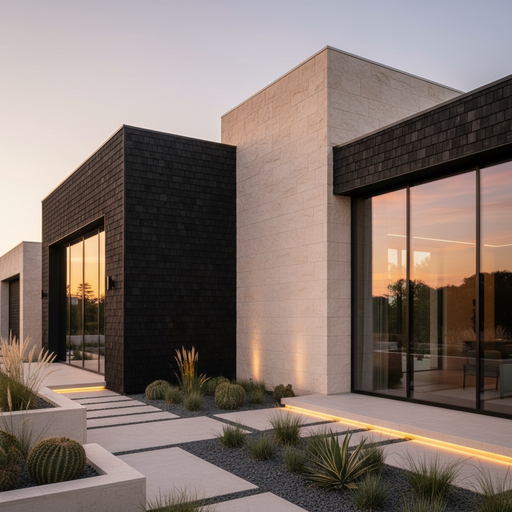
The most stuing custom homes rarely rely on a single material. The magic happens in the mix. Think of your exterior materials as a wardrobe. You wouldn’t wear a tuxedo made entirely of one fabric; you mix the wool of the suit with the silk of the lapel and the cotton of the shirt. The same applies to your home.
A common design strategy is the “70-20-10” rule. 70% of the exterior might be a primary material like white stucco, 20% could be a secondary accent like warm cedar planks around the entrance, and 10% could be a bold “jewelry” piece, like black metal window frames or a custom copper gutter system. This layering creates visual depth and guides the visitor’s eye to the focal points of the architecture, such as the front door or a dramatic cantilever.
Sustainability: Building for the Future
In today’s world, custom selection is also a moral choice. Many homeowners are looking for “green” materials that reduce their carbon footprint. This includes salvaged wood, stone sourced from local quarries to reduce transport emissions, and high-tech options like solar shingles that blend seamlessly into the roofline.
Choosing durable materials is, in itself, a form of sustainability. A roof that lasts 50 years is far better for the planet than one that needs to be replaced every 15. When selecting your palette, ask about the lifecycle of the material. Where did it come from? How much maintenance does it need? Can it be recycled? A beautiful home feels even better when it sits lightly on the earth.
Conclusion: Crafting Your Legacy
Selecting custom exterior materials is a balancing act between the heart and the head. It requires you to be part poet and part engineer. You must consider the R-value of your insulation and the wind-load of your siding, but you must also consider how the texture of a stone wall will look under a porch light on a snowy evening.
Your home is likely the largest investment you will ever make, but more importantly, it is the backdrop for your life’s most precious moments. By choosing materials that reflect your style, respect the environment, and stand the test of time, you aren’t just building a house. You are crafting a legacy. So, take your time. Touch the samples. See how they look in the morning light and the evening shadows. Your story is waiting to be told, one stone, one plank, and one brick at a time.


